


Proper waste separation is the last thing on most students’ minds. A school waste station has to do that thinking for them, planned around the people using the space. Put the bins in the wrong spot or leave off clear signs, and food ends up in the recycling or on the ground.
This guide walks facility managers and design teams through each planning decision, based on what we’ve learned in our 70+ years of making school rubbish bins and multi-bin waste stations throughout Australia.
Waste fact: More than a third of what schools throw away is organic waste. Less than 1% of it is collected as organics.
School Waste Station Planning Checklist: At a Glance
- Run a waste audit or estimate one for a new school to determine what the school throws away and where.
- Ask the council or waste contractor which waste streams they collect.
- Work out how fast each spot fills, choosing bin capacity to suit.
- Place every station on a route students always walk.
- Match signs and bin order across the school for easier use.
- Test that all ages, as well as wheelchair users, can easily reach the bin openings.
- Cover outdoor bins, locking and bolting them down.
- Leave room for cleaners to maintain bins.
- Check what’s ending up in each bin after the first term.
Start With a School Waste Audit
Guessing how much waste a school produces or where bins need to go is leaving far too much to chance. By starting with a school waste audit, you’re planning from actual numbers that tell you exactly what is needed and where. It also gives schools a baseline for measuring school sustainability progress over time.
The NSW Department of Education recommends auditing a representative sample. For example, they suggest getting students involved in the process, labelling buckets and measuring how much of each type of waste is generated from:
- Individual classrooms, measuring how much paper waste is generated.
- Eating areas and canteens after lunch breaks, comparing waste from lunchboxes versus the canteen.
- Staff areas.
- Outdoor spaces.
It’s important to also note when waste contamination is affecting recycling with food or general rubbish.
For new schools, there isn’t anything to monitor yet. This is where an estimate is appropriate, using projected enrolments and the planned eating areas, classrooms, staff areas and outdoor spaces to compare against a campus of a similar size. After the campus has been open for a term, an audit can then confirm the data.
“The best briefs we receive come with audit data attached. Once we know a canteen area fills 240-litre general waste bins on an average day, and that most of that waste is food, we can talk about bays and openings straight away.”
— Luke Gurney, Product Manager, Draffin Street Furniture
Decide Which Waste Streams Your School Needs
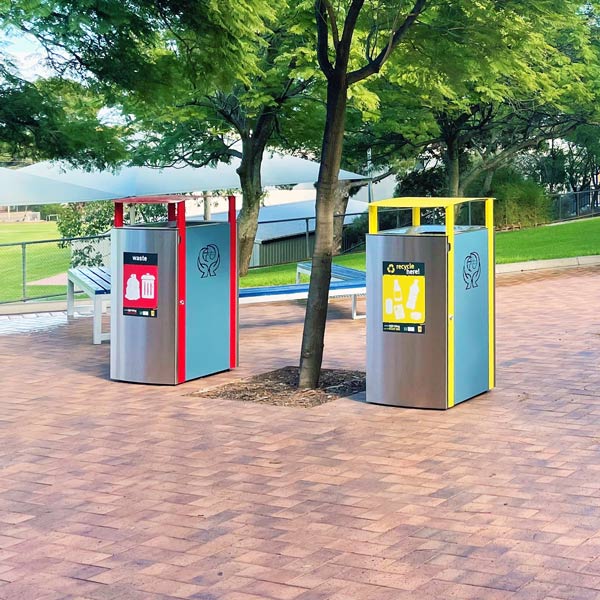
There’s no point setting up multi-bin waste stations if there’s no one to collect the rubbish itself. This is why planning should also work around what the council or waste contractor for the school’s area will collect and their schedule for those collections. Once you have confirmed the information, you can decide if each spot needs a simple pair of school recycling bins and school rubbish bins, or a larger recycling station with more streams.
| Waste stream | Usually accepts | Confirm before specifying |
| General waste | Items that can’t be recycled or composted locally | What bin sizes can be collected, how often and on what days they’re picked up |
| Mixed recycling | Paper, cardboard, bottles and cans | Whether glass is collected separately |
| Organics (food organics or FOGO) | Food scraps and maybe garden organics | If green waste can be collected |
| Other streams, where needed | Container deposit items or soft plastics, depending on the state | Whether volumes justify a dedicated bay and there is someone who can facilitate the collection |
Each of these factors can vary between states and regions too, so they should only be used as a starting point. What waste can be collected and under what lid colour should be confirmed with the school’s local council or waste contractor before school waste stations are specified to make sure the plan works efficiently for the campus.
Choose the Right Number and Capacity of Bins
One bin size or schedule may not work across an entire school. Taking into consideration how quickly a bin in a canteen or eating area will fill up versus one near a library can help with specifying options that will keep waste under control.
To assess the suitable bin capacity for each area, look at:
- Student numbers at peak break times and how they use the space.
- Volume of each stream from the audit.
- Collection frequency.
- High-traffic spots versus quieter spots.
Once you’ve worked through each of these, you’ll know roughly how much each bin needs to hold for every spot. Then, you can pick the school rubbish bins to suit.
Draffin’s Wheelie Bin Corral makes it easy to specify to each location’s needs. It takes 120 L or 240 L bins in dual, triple and quad configurations, meaning it can hold as little as 240 L or as much as 960 L. Our wider range of wheelie bin surrounds can also accommodate two bin sizes. A bay can be added later if the area turns out busier than expected.
Where Should Waste Stations Be Located Around a School?
Kids are more likely to use bins when they’re in their path. When you know which bins you need and the size, you can focus on bin placement that will increase the likelihood of them being used, while still making it easy for them to be opened and cleaned.
Eating and recreation areas
Students rarely carry rubbish far once the bell goes. Placing a school waste station on the path leading away from tables or on the edges of an oval or court helps catch them as they leave. It can help to plan bins alongside tables and seating for the wider outdoor school furniture layout to ensure the school waste management plan works for the campus.
Canteens and food areas
Waste around the canteen can happen within just a few steps of the counter where students take wrappers off food. Having a bin within sight of the counter but out of the queue can help deal with that. Consider bins for recyclable packaging as well as food scraps.
Entrances and high-traffic areas
School gates and bus bays usually collect drink containers and wrappers at the start and end of the day. So, a compact dual-bay waste station installed back from the path is usually enough.
Indoor vs outdoor requirements
Any outdoor school bins need a cover to keep rain out and a fixing to the ground, while indoor bins may need to be more compact to fit in tight spaces. For those tight spaces, our Triple Tub Internal Recycling Bin from Draffin can hold three 57 L galvanised liners and be fitted with casters, also available in a wide range of colours to suit the interior or school branding.
Collection and servicing
Something important to remember is that each bin has to be wheeled out by someone to the collection point, which can be tricky when they’re full. With this in mind, every station should have a firm and level route out that’s wide enough for the maximum bin capacity.
Make Waste Sorting Easy for Students and Staff
When their minds are on play or getting to their next class, students need to be able to choose the right bin in seconds. To help make the decision quick and easy, Western Australia’s WasteSorted Schools program recommends consistent waste stations across the campus, with standard bin colours and matching signs for each stream. For example, this may include specifying for:
- Clear, consistent bin signage, with pictures of common items for younger students.
- Colour coding and other visual cues on lids and signs that match the collection bins.
- Every stream to be positioned together, so bins don’t stand alone.
- The same left-to-right order at each school waste station on campus.
- Openings shaped to the stream, such as a round opening for containers, helping to reduce the risk of contamination from food waste in recycling.
This can be made simple with an option like Draffin’s Hub Bin Surround with Sign, which has built-in waste-type signage, with a panel above each bay that can be read from a distance. Our signage guide shows the standard decal options.
How Clear Signage for Bins Can Work in Practice
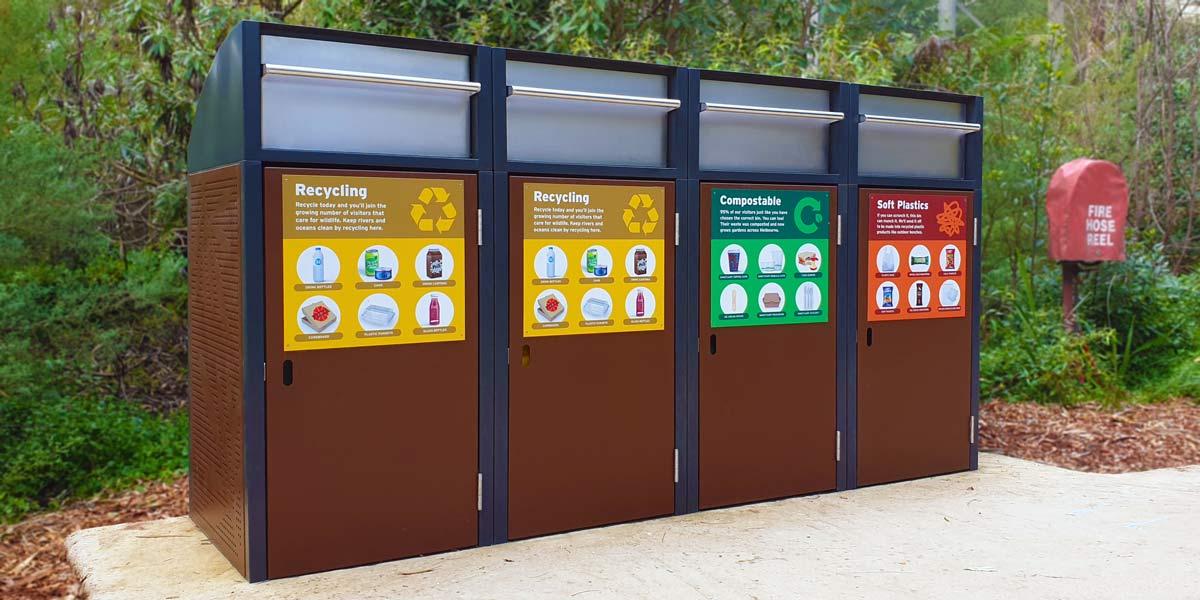
Healesville Sanctuary worked with Draffin to introduce a three-bin system across its grounds, making sure every food and drink outlet used compostable or recyclable packaging that fits the bins. Draffin designed and built the bin surrounds to carry the sanctuary’s existing signage, prioritising communication. We also developed a weighted chute that kids can push open but a brushtail possum cannot. It works because the packaging sold on site matches the bins. The signage then backs it up.
Consider Accessibility, Durability and Security
Everyone in a school needs to be able to reach and use a bin for it to work the way it’s planned. They also need to account for where they are, like the elements if they’re outdoors or how easy they may be for the wind or a passer-by to knock them over.
Accessibility
Where possible, students should be able to use bins without help from an adult, including the youngest students and anyone in a wheelchair. Height is the first thing to check when planning accessible bins, because a surround for 240 L bins is taller than one for 120 L bins. A frogmouth opening also lets waste go in with one hand.
Wheelchair users also need clear and level space around accessible bins to get close enough to use them. The exact requirements can vary between schools and bin locations, so check with the access consultant and start with our guide to outdoor school furniture compliance.
Durability
Outdoor bins are usually sitting in the sun and rain all year. So, the specification needs to account for keeping water out and litter in, such as with a self-closing design like the 900 Series Pivot Chute Cover Bin Surround. This solution also keeps wildlife out as well.
Security
Schools are high-use environments, and loose wheelie bins are at risk of being moved or tipped over. Wheelie bin enclosures that are fixed in place can help secure waste stations that sit out in the open, such as the Wheelie Bin Corral that can hold every bin with a single lock. They can also be bolted down or set on in-ground anchors.
“Hundreds of students can use the same waste station several times a day, so we look closely at hinges and locks. A door that won’t close properly by the end of the term changes how it gets used.”
— Luke Gurney, Product Manager, Draffin Street Furniture
Plan for Emptying, Cleaning and Ongoing Maintenance
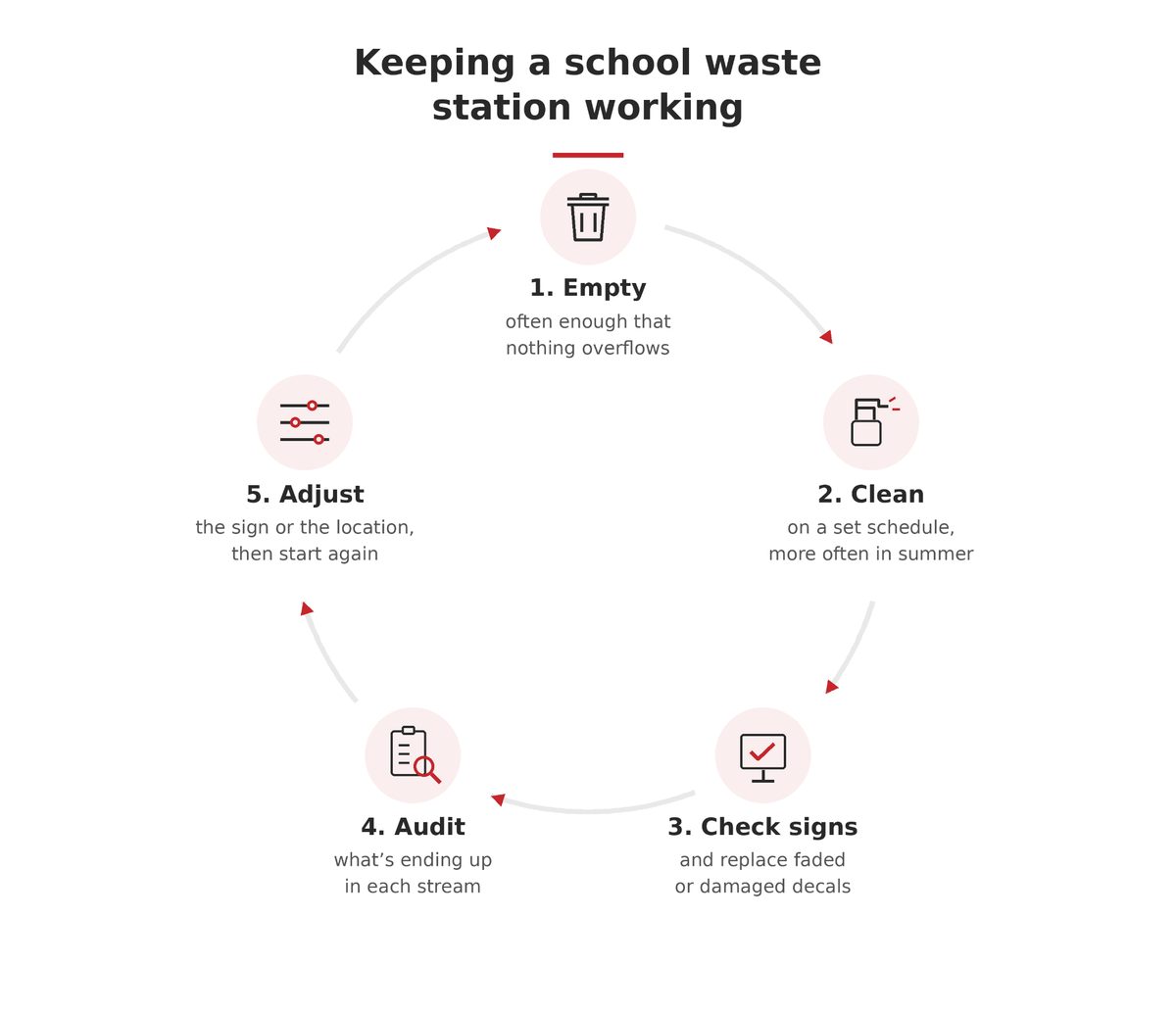
While students may only use school waste stations for a few seconds, cleaners deal with them every day. And a unit that’s awkward to empty can soon stop being emptied properly. It’s important every bin considers how they’ll be used by both students and cleaning staff before a product is specified to make sure they work for everyone involved.
Some factors to consider include:
- Access, ensuring there’s enough room around each unit for doors to open fully and the bin to be pulled out straight.
- Using liners for lighter bins, such as indoor waste, or wheelie bins if there’s enough room for them to be wheeled out.
- How often bins need to be emptied, and which capacity may help.
- The cleaning and maintenance schedule, especially in summer when food waste can smell quickly.
- Signage, replacing damaged or faded decals as soon as possible.
Usually, anything the plan got wrong will show up in the first term. This is why WasteSorted Schools suggests regularly auditing bins and seeing what’s ending up in each stream. If one spot keeps collecting the wrong things, changing the sign or location, or potentially both may be a solution to look at.
How to Choose the Right Multi-Bin Waste Station for Your School?
Once you know the waste streams and bin capacity needed for each location, choosing a multi-bin waste station gets easier. Simply allow for one bay per stream and leave room to add another, so a pair of bins can grow into a full recycling station as the school’s needs change. These are four of our most popular bins and litter solutions at Draffin that suit most spots in schools.
| Option | Indoor or outdoor | Configuration | Best suited for |
| Wheelie Bin Corral | Outdoor | 120 L or 240 L bins in dual, triple or quad bays | Ovals and event areas |
| Hub Bin Surround with Sign | Either | Single, dual or triple bays with signs for each type of waste | Eating areas and school entrances |
| 900 Series Bin Surrounds | Outdoor | Batten-clad bays with a choice of covers | Landscaped courtyards |
| Triple Tub Internal Recycling Bin | Indoor | Three 57 L liners in one freestanding unit | Corridors and staff areas |
This stage is also where you can customise finishes and signage to suit the school and area. Using powder-coated panels, we can finish each bin or surround in school colours, even adding a school logo or custom decals, if required.
A Matched Palette at Matthew Flinders Anglican College
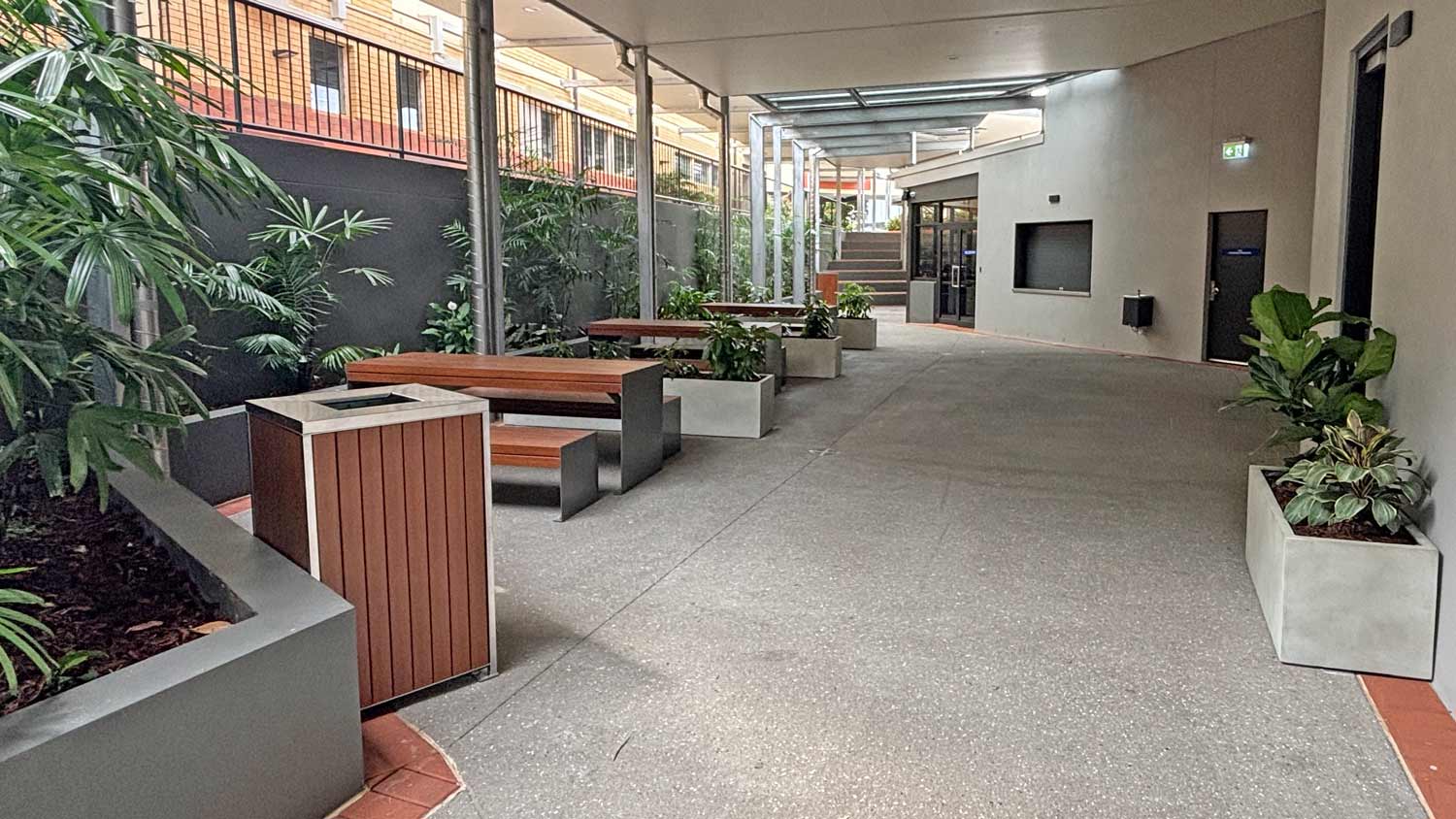
At Matthew Flinders Anglican College in Buderim, Year 10 design students helped shape The Cove, a courtyard located beside the tuckshop that opened in November 2025. Draffin supplied 900 Series bin surrounds with the tables and planter benches, all in Woodland Grey powdercoat and Ironbark timber-look aluminium battens. This means waste can be handled where it’s generated while the waste stations still blend in with the area.
Plan Your School Waste Station With Draffin
Draffin has been making furniture and bin enclosures for Australian schools for more than 70 years. With our range of configurable and durable school waste stations, we can help turn your audit findings and school sustainability goals into a specification or a custom design where a standard option won’t fit.
Our product pages include downloadable specification sheets, and a 3D configurator lets you choose colours and finishes before requesting a quote. All of our school rubbish bins and stations are also Australian-made and delivered nationally, including to regional schools.
Explore our bins and litter solutions or speak with our team at Draffin about your project.