


Tree seating is common in Australian streetscapes, parks, and civic precincts. But most tree seats are designed for aesthetics first, with tree health and pedestrian flow as an afterthought. Poorly planned installations can restrict tree growth, accelerate asset deterioration, and introduce long-term maintenance and safety issues. When approached correctly, however, it allows trees to thrive in the public realm.
In this guide, we break down the practical considerations behind tree seating design. We explain how to install tree seating in a way that supports tree health and natural pedestrian flow, and how to choose materials that balance durability with comfort.
Why Tree Seating is More Complex than it Looks
The challenge with tree seating lies in the design. We’ve seen this happen too often: the tree-seating design is completed first, then “fitted” to tightly wrap around an existing trunk. While visually neat at installation, these solutions rarely account for ongoing growth. Effective design recognises that tree trunks expand continuously, root systems extend beyond visible canopies, and compacted soil limits water and oxygen uptake.
But this doesn’t mean tree seating isn’t a good solution for public space design or placemaking. What it actually points to is a change in perspective: thinking of tree seating as a living system rather than just furniture. Designing effectively is what separates short-term solutions from long-lasting street furniture.
Designing for Tree Health
Designing for tree health means that tree seating is not a static object; it is part of an important living system that evolves over time. Effective tree seating considers the tree an active part of the design process.
Understanding the Role of AS 4970 in Tree Seating Design
AS 4970:2025: Protection of Trees on Development Sites is often referenced in discussions around tree seating. The standard is primarily designed to protect existing, retained trees during construction projects. According to this standard, there are two key elements to think about when constructing around existing trees:
- Tree Protection Zone (TPZ): the minimum area around a tree within which no construction or seating structures should encroach to ensure tree health
- Structural Root Zone (SRZ): the immediate area around the base of a tree that should not be encroached to maintain root health.
In many public realm projects, tree seating is introduced as part of a broader landscape upgrade that includes new tree planting. If you’re planting new trees, you do not need to apply AS 4970, as it is meant for existing trees.
A more effective approach is to apply AS 4970 rigorously when working near valuable existing trees. This makes urban tree management straightforward. Or, plan seating and new trees together in new installations, and coordinate with an arborist from the outset to help you understand how much allowance you need to make for long-term trunk and root growth.
Why New Tree Plantings Offer Greater Design Flexibility
When used around new or young trees, tree seating allows teams to:
- Provide adequate soil volume and drainage
- Maintain appropriate trunk clearances over time
- Locate footings and fixings away from future root growth
- Avoid disruption to established trees altogether
In these contexts, try not to centre the design on a fixed circular layout. Options that offset seating slightly from the trunks — such as semi-circular, curved, or segmented seats — can be positioned adjacent to tree pits or planted areas without enclosing the entire tree. This keeps structural elements outside the anticipated growth zones.
The result is a solution that reduces pressure on the tree, maintains permeable zones around the planting area, supports shade, comfort and social use while remaining flexible as the landscape matures.
Draffin Street Furniture’s tree seats are designed with this growth in mind. Modular configurations and custom sizing make it easy to maintain appropriate clearances around the trunk and root protection zone. Options such as in-ground or surface-mounted fixing, as well as configurations with or without backrests, allow the seating to adapt to both the tree and the surrounding environment. This means designers and contractors can meet arborist recommendations while still delivering a practical installation without compromising on usability or long-term performance.
Designing for Human Behaviour (Not Just Seating)
People interact with tree seating differently depending on context, time of day, and environmental conditions. When designing tree seating, think about how community members use public spaces. We find that seating near trees is often valued more for the microclimate and visual comfort they provide. Good tree seating outcomes typically result from:
- Aligning seating with natural shade patterns, such as under the tree canopy, so that they can be used even when it’s sunny
- Positioning seats where people already pause or dwell to increase informal meeting or gathering points
- Providing comfortable resting points along longer walking routes
- Avoiding overly complex forms that restrict informal use
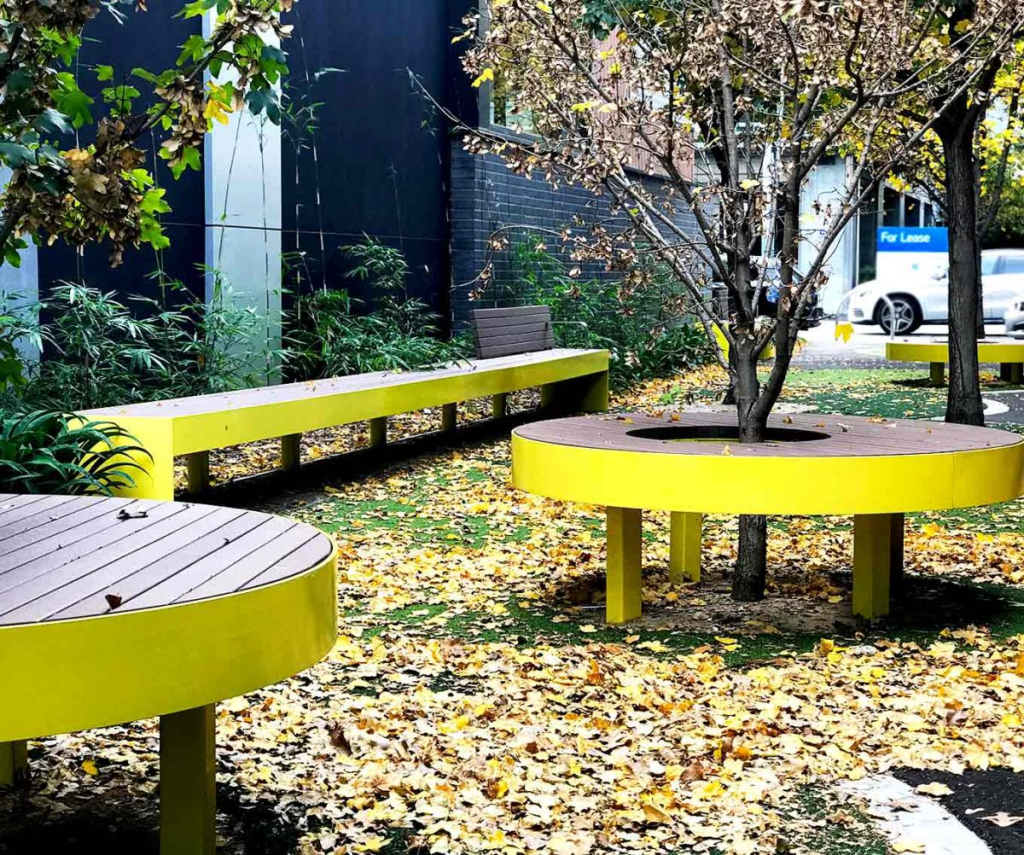
The Hartwell Shopping Area project is a strong example of this approach in practice. Draffin Street Furniture manufactured custom bench solutions to work with existing trees and pedestrian flow, offering people a space to rest within a busy shopping precinct. This supports informal social interaction without compromising tree health. Read more about how our tree seating enhances urban design.
Integrating Pedestrian Movement and Flow
Tree seating shouldn’t be thought of as an object, but as part of pedestrian behaviour. Tree seating is a subtle tool for guiding movement through public spaces, providing areas for rest and interaction, and preventing pedestrian “gridlock” in busy areas. Here’s what to think about when designing tree seating:
- Respect desire paths and circulation routes: People naturally create desire paths, i.e, the shortest or most comfortable routes. Map pedestrian flow first (where people already walk) and position seating outside main circulation corridors.
- Align seating with movement: Install seating parallel to the walking paths. Create “pause zones” slightly offset from movement paths so seated users can observe the flow without sitting in it.
- Consider sightlines and safety: Obstructions aren’t just physical — they can be visual, too. Avoid tall or bulky seating that hides movement. Maintain a sense of openness so people can anticipate others’ paths.
- Use gaps or breaks to accommodate movement: Solid circular benches around trees often create hard obstacles. Instead, use semi-circular configurations to leave gaps that allow people to pass through naturally.
Common Tree Seating Design Mistakes (And How to Avoid Them)
Even well-intentioned designs can have these common mistakes:
Ignoring accessibility requirements
Compliance with Disability Discrimination Act (DDA) and AS 1428 standards must be balanced alongside tree protection zones.
Selecting unsuitable tree species
Some species are less compatible with urban environments. Get an arborist’s input to find the right trees for your space and climate. We’ve seen design failures where fixed circular seating restricts tree growth.
Blocking circulation
While trunk growth is often considered, root protection requires equal attention to space, soil quality, and water and oxygen permeability.
Construction-related damage
Heavy machinery, excavation, and rough substrate preparation can cause harm to the soil, which can affect the tree’s long-term health.
Poor material selection
Choosing the right materials for tree seating is not as simple as choosing the most affordable option. The wrong material, for example, one that retains heat and has no shade, will not be comfortable or usable.
Choosing the Right Materials for Tree Seating
Here’s a comparison of commonly used tree seating materials:
Timber
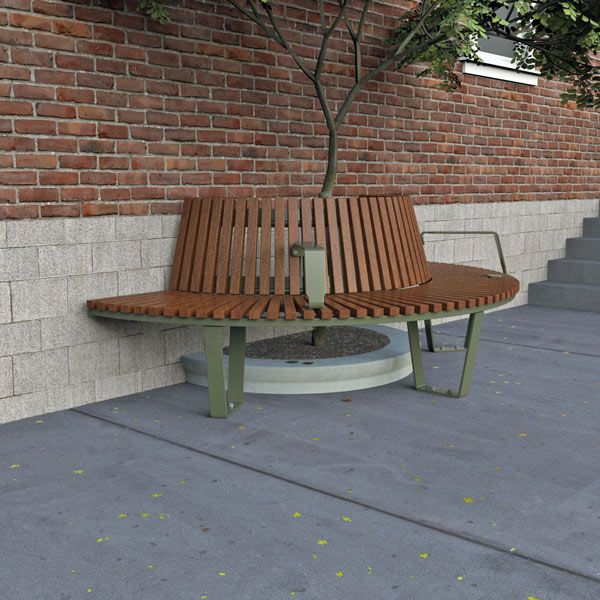
Timber is ideal for natural, human-centred environments due to its ability to blend with landscapes. It does not overheat or become too cold, making it pleasant to sit on, and it softens the feel of urban spaces. We recommend timber in spaces where comfort and aesthetics are priorities.
Maintenance requirements: High
Timber needs ongoing treatment. At Draffin Street Furniture, we recommend annual maintenance such as sealing or oiling.
Aluminium
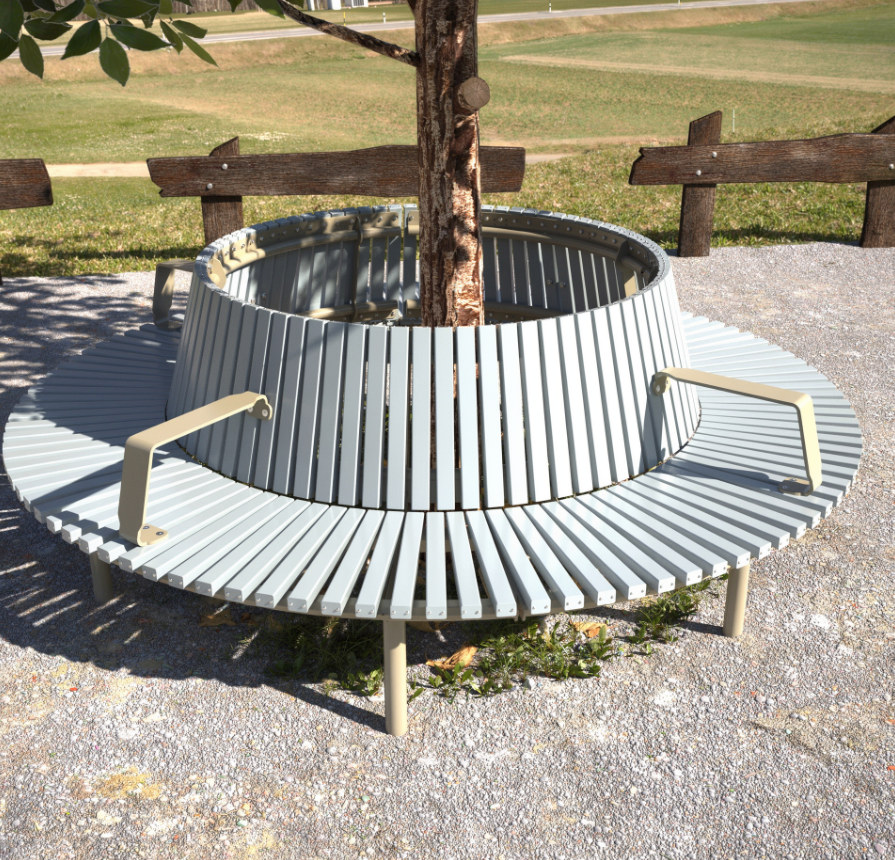
Aluminium is a lightweight, low-maintenance material suited to contemporary urban settings. It is highly corrosion-resistant, with minimal upkeep required. However, it can heat up quickly and may be uncomfortable to sit on if there is no shade.
Maintenance requirements: Low
Maintenance is low, typically limited to occasional cleaning and inspection for surface damage.
Galvanised Steel
Galvanised steel is strong and durable, making it suitable for high-traffic or vandalism-prone areas. Its zinc coating protects against corrosion and ensures a long lifespan. It has an industrial look, and we recommend installing it in urban environments.
Maintenance requirements: Low
Maintenance is low, typically limited to occasional cleaning and inspection for surface damage.
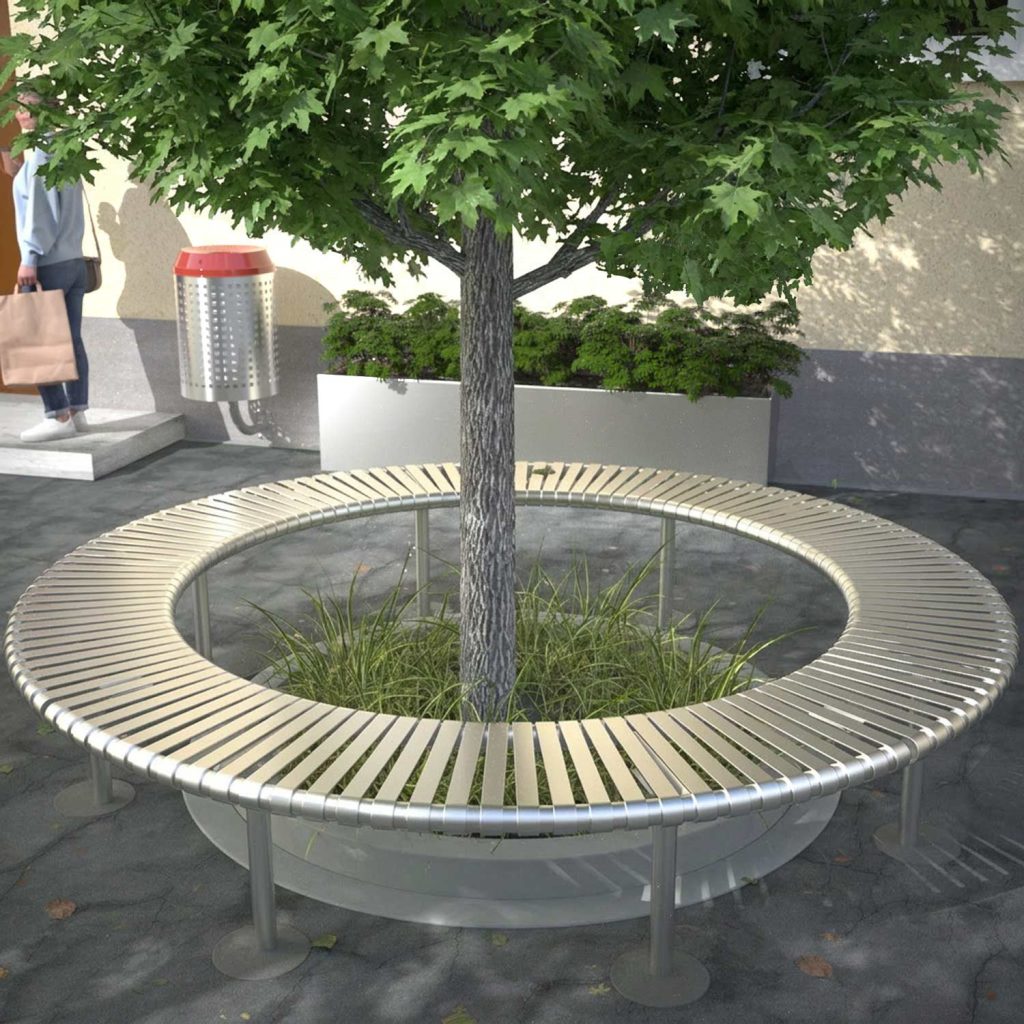
Stainless Steel
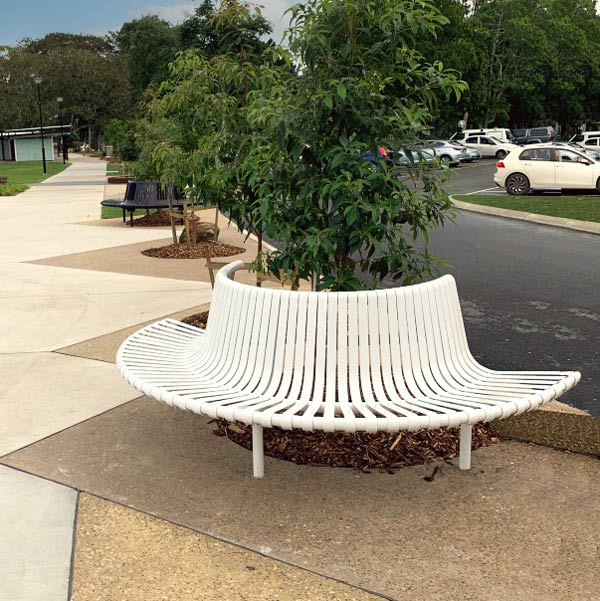
Stainless steel is a high-end, long-lasting material with excellent corrosion resistance, especially in harsh environments. It has a clean, modern appearance. It is a high-end solution that can adapt to a range of climate conditions.
Maintenance requirements: Low
Maintenance is minimal, usually limited to occasional cleaning and inspecting for scratches or impact damage.
The right choice depends on the project context, expected usage, and maintenance strategy. For a deeper dive, see Draffin’s guide to different materials used for street furniture.
The Draffin Tree Seating Design Checklist
This is a checklist you can use while designing tree seating:
- Provide clearances for both trunk and root growth;
- Do not compress the soil or roots during installation;
- Use the tree canopy for natural shade;
- Align tree seating with pedestrian movement patterns; and
- Select a material that can withstand environmental exposure and community use.
Designing Tree Seating for Longevity and Adaptability with Draffin Street Furniture
Successful tree seating design is not about fitting furniture around a tree. When approached correctly, tree seating becomes a key element in shaping functional, sustainable, and human-centred urban environments.
At Draffin Street Furniture, we design and manufacture tree seating that supports long-term performance and work closely with designers, landscape architects, and councils all over Australia. If you’re specifying tree seating for a council or commercial project, contact our team to discuss configurations and how we can find a solution for your space and community.