

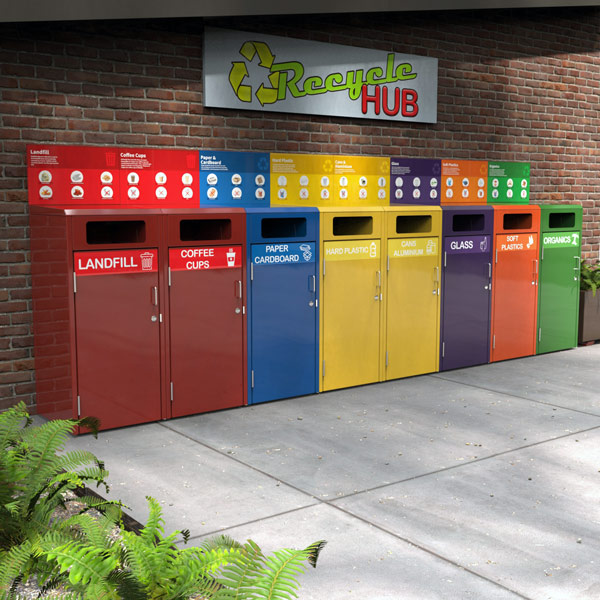
The design of public bins plays a bigger role in waste management than many people realise. From reducing litter and recycling contamination to improving collection efficiency and encouraging correct disposal, well-designed bin infrastructure can significantly impact how public spaces function.
For councils, architects, landscape architects, and urban designers, creating better waste outcomes is not simply about providing more bins. It is about understanding how people move through public spaces, where they are most likely to dispose of waste, and how bin design influences decision-making. This article explores why bin design matters and the key considerations for creating more effective public waste solutions.
Table of Contents
- The Reason Why Urban Waste Infrastructure Often Fails Outside Controlled Environments
- The Hidden Variable — Bin Placement and Human Movement Patterns
- From Objects to Systems: Rethinking Public Waste Infrastructure
- Design Principles That Improve Public Waste Outcomes
- The Cost of Getting Public Bin Design Wrong
- Container Deposit Schemes (CDS) and the Shift Toward Recovery Design
- How Infrastructure Design Changes Outcomes (Not Just Behaviour)
- Designing for Real Public Use, Not Ideal Behaviour
The Reason Why Urban Waste Infrastructure Often Fails Outside Controlled Environments
In public environments, such as streetscapes, parks, shopping precincts, and civic spaces, people move quickly and rarely stop to think about waste disposal. Users also vary widely in age, literacy, language, and familiarity with local systems. Decisions are instinctive, so people typically choose the least confusing bin, even if it’s incorrect. This ends up being the general waste bin.
As a consequence, general and recyclable waste ends up commingling. Wet materials and food residues contaminate otherwise valid recyclable materials, such as oil stains on plastic food containers. When contaminated, waste cannot be processed at recycling facilities and instead ends up in landfills.
Commingling is often incorrectly interpreted by councils as proof that people simply “will not recycle properly in public”. This is not laziness or a lack of education. Even well-intentioned users struggle with:
- poorly positioned bins
- confusing stream separation
- inaccessible disposal points
- unclear visual cues
This distinction matters because it reframes the issue. The problem is not necessarily the education around multi-stream waste bins. The problem is deploying outdoor bins and litter solutions without considering the environment or users.
This explains why multi-stream public bins often struggle in open public environments and streetscapes, but succeed in more controlled settings, such as universities, stadiums, airports, and newly developed precincts. Controlled spaces are carefully managed with more predictable movement patterns, frequent servicing, staff oversight, and deliberate bin placement strategies.
The Hidden Variable — Bin Placement and Human Movement Patterns
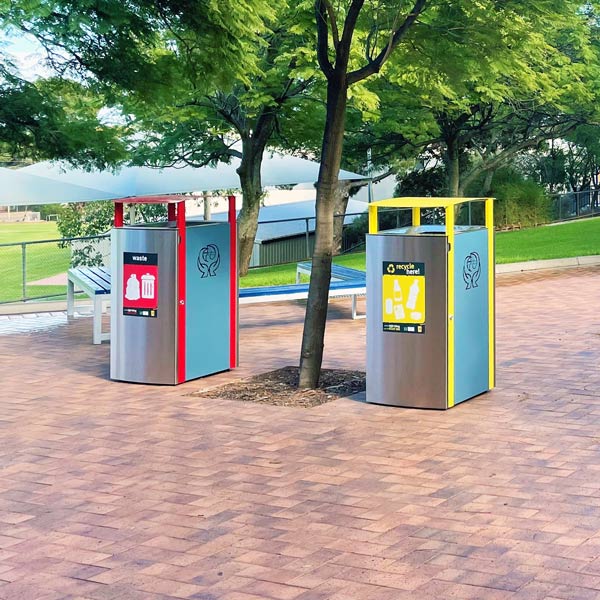
One of the most overlooked factors is bin placement and movement psychology. People dispose of waste at natural trigger points such as building exits, waiting areas, seating zones, transport hubs, toilets, and pathway intersections where movement slows or pauses. When bins are placed within these natural movement paths, they’re more convenient to use.
A common knee-jerk design/placement error is actively trying to distance a bin array away from entrances, exits, intersections, and natural pause points to maintain aesthetics. This is where bins are needed the most!
– Luke Gurney
Product Manager at Draffin Street Furniture
When bins are positioned outside natural movement zones, people may choose the wrong stream or repeatedly choose the closest bin, making it overflow. A well-designed bin placed in the wrong location will still produce poor outcomes.
From Objects to Systems: Rethinking Public Waste Infrastructure
The traditional approach to bin design has been a procurement exercise: select a bin, install it, and service it regularly. But at Draffin Street Furniture, we recommend a different approach.
Effective urban waste infrastructure requires a “systems approach”. This means public bins should function as a part of the wider space, rather than standalone assets scattered throughout an environment. In practice, this means depending less on the individual product specification, and more on its integration into the environment.
For more information, read about choosing public bins for high-traffic public areas.
In a systems approach, councils and architects think about the bin interacting with:
- Bin placement,
- Servicing frequency,
- User behaviour,
- Stream complexity,
- Signage, and
- Environmental design.
Solutions like Draffin’s HUB bin surrounds (1800 Series) are designed specifically around this systems-thinking approach. They enable a clear separation of waste streams (recycling, landfill, organics, glass). They provide consistent signage and visual cues across a site. With modular configurations and durable enclosures, they can withstand heavy public use in different environments.
To discuss how to specify public bins that integrate into your particular site and meet your community’s needs, contact the team at Draffin Street Furniture.
Design Principles That Improve Public Waste Outcomes
1. Align Placement With Human Movement
Bins should be positioned where disposal naturally occurs, not where users have to look for them. A study by the University of British Columbia suggests that bins placed along natural movement paths can increase the rates of proper waste separation and recycling.
2. Reduce Friction in Disposal Decisions
Clear visual communication, intuitive openings, and simplified stream choices improve participation and simplify decision-making in public environments. This ultimately reduces recycling contamination in public spaces.
3. Clear Labelling
A clearly labelled bin also reduces contamination — red for general waste, yellow for recycling, and green for organic waste. Other physical cues, such as shape, size, and aperture, also guide decision-making.
4. Match Stream Complexity to the Environment
Not every public environment is suited to multi-stream separation. Match the system to the community’s needs and servicing capacity. Simple systems often outperform overly complex configurations in high-traffic or remote areas.
For example, in a remote nature reserve, extensive bin separation (landfill, paper and cardboard, glass, aluminium and cans, hard plastic, soft plastic, and organics) is unnecessary. A simple 3-bin system for general landfill waste, organic waste, and recyclables will meet user needs, and will be serviceable by councils.
5. Integrate Waste Infrastructure Into Streetscape Planning
Streetscape bin design should be considered alongside landscaping design, seating, and other public amenity planning. Wheelie bin surrounds should look like they belong in the streetscape while still being visible.
6. Prioritise Durability and Serviceability
Public environments place significant operational pressure on infrastructure. Systems must be durable, low-maintenance, and practical to service. Read about the different materials and construction methods that Draffin Street Furniture uses for outdoor bin surrounds and which environments they’re suited to.
7. Accessibility for All Users
Bins in public use spaces will be used by people of all ages and abilities. The bin aperture should be low enough to be accessible to people with mobility challenges, wheelchair users, children, and seniors. Accessibility requirements are determined by the Disability Discrimination Act (DDA) and the National Construction Code (NCC).
A Case Study of Infrastructure-Led Design: Bin Surrounds in Belgrave
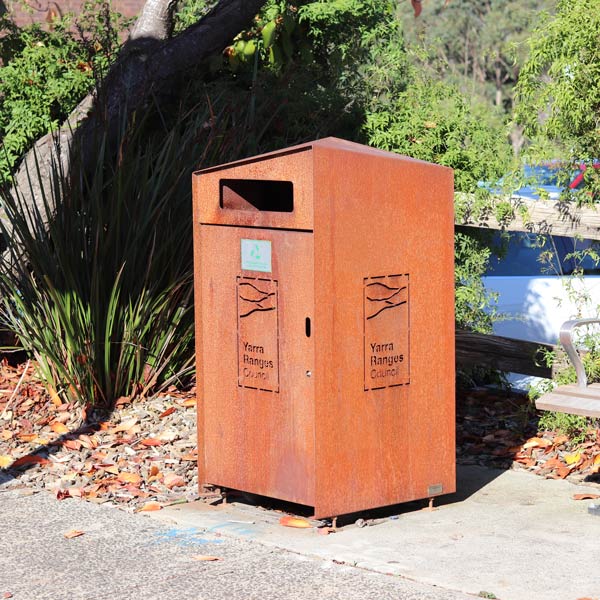
Draffin Street Furniture designed, manufactured, and supplied Hobart Bin Surrounds for the Yarra Ranges Council, creating a waste solution suited to Belgrave’s natural environment, the council’s operational needs, and the community’s needs.
The project reflects the principle of integrating waste infrastructure into streetscape planning. Constructed from weathering steel, the bin surrounds visually complement the surrounding greenery and public landscaping while remaining highly visible to users. The material choice also supports durability and serviceability. Unlike painted finishes that may chip or fade, weathering steel develops a protective patina over time, improving corrosion resistance and reducing long-term maintenance requirements in exposed outdoor conditions.
The project also demonstrates the importance of consistency in public waste systems. The council implemented a uniform bin design throughout the Belgrave and greater Yarra Ranges area. Consistent visual cues can reduce confusion and encourage proper waste disposal in shared environments. Custom laser-cut Yarra Ranges Council branding further strengthened the connection between the infrastructure and the local community identity.
The Cost of Getting Public Bin Design Wrong
Poor public waste system design has serious operational and environmental consequences over time.
Operational impacts include:
- Higher servicing frequency: Poor bin placement can cause the most conveniently placed bins to fill faster than expected, requiring more frequent collection. This increases councils’ labour, transport, and servicing costs over time.
- Increased overflow incidents: When bins are difficult to access, litter and overflow become more common in accessible bins. Overflowing bins create hygiene issues and increase street cleaning requirements.
- Reduced system efficiency: Waste systems that are difficult to service or poorly suited to the environment place additional pressure on councils and maintenance teams.
Environmental impacts include:
- Lower recycling recovery rates: Complex or unclear bin systems often lead to higher contamination rates. Contaminated recycling loads cannot be processed and must be redirected to landfill, reducing overall resource recovery outcomes.
- Increased landfill contribution: When recycling systems fail, more waste is sent to landfill rather than recovered or reused. This increases environmental pressure.
- Reduced circular economy performance: Public waste systems play an important role in supporting material recovery and reuse. Ineffective infrastructure limits councils and communities’ ability to participate in circular economy initiatives.
Container Deposit Schemes (CDS) and the Shift Toward Recovery Design
Every state in Australia now operates a Container Deposit Scheme (CDS) which allows you to return eligible drink containers for a 10-cent refund. Eligible drink containers include most aluminium cans, glass, plastic, and cartons between 150 mL and 3L. Australia’s Container Deposit Scheme (CDS) network has created growing interest in simpler, recovery-focused public waste interventions.
Drink containers are among the most recoverable materials in public environments, yet many still end up contaminated in general co-mingled waste streams. One emerging approach that makes the most of existing public waste infrastructure is to attach side-mounted CDS collection baskets to public bins. These baskets separate high-value recyclables before contamination occurs. They provide low-friction opportunities for users to leave or collect recyclable containers, encouraging community participation. No behaviour change is required among users, and the solution doesn’t require full multi-stream infrastructure, like adding a new bin that may confuse users.
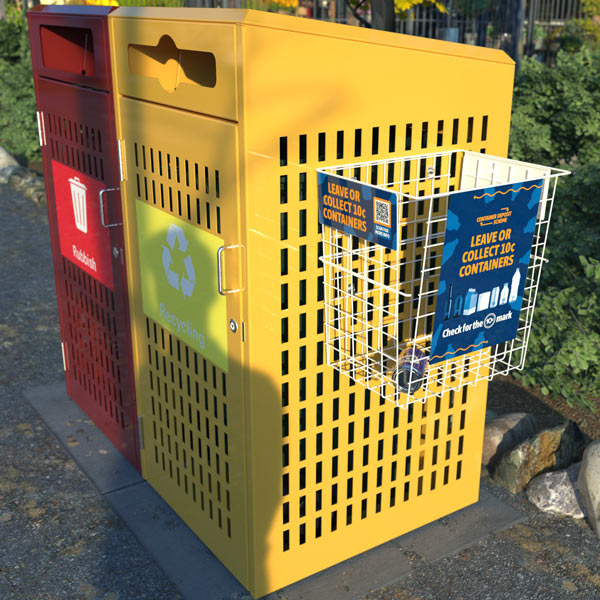
The benefit is twofold: recovery rates improve, and contamination pressure on general and recycled waste streams decreases. Importantly, this solution succeeds because it reduces behavioural complexity rather than increasing it. Again, the lesson is the same: infrastructure design shapes outcomes.
How Infrastructure Design Changes Outcomes (Not Just Behaviour)
Well-thought-out public waste bin design makes correct behaviour feel effortless. Poorly designed systems make even well-intentioned and motivated users fail. This principle applies across every aspect of urban design, and waste infrastructure is no exception. When public waste systems align with movement patterns, convenience, accessibility, and visibility, correct disposal behaviour becomes significantly more likely.
The Western Australia Container Deposit Scheme — Containers for Change — is an example of this principle in action. At the time of the scheme’s launch (October 2020), the state’s overall recovery rate was 34%. By June 2024, it increased to 64%. This shows that behaviour follows infrastructure more often than intention.
Designing Smarter Public Waste Systems: From a Manufacturer’s Perspective
Smarter public waste outcomes begin earlier in the design process and take a systems approach. Waste strategy should not be treated as a final-stage infrastructure addition.
Start with an audit that reviews your current waste infrastructure. We often find that bins are placed too close to obstacles like trees, or people have to walk too far to use them. Following this, discuss your community’s needs and council maintenance schedule. Then create and install bins that reduce friction and improve your entire environment’s performance. From modular systems like the HUB bin surrounds to simpler, time-proven canopy-cover bin surrounds, we can help find the right solution for your space.
Designing for Real Public Use, Not Ideal Behaviour
Better public waste outcomes are not achieved simply through more education about litter prevention. They are achieved through infrastructure that reduces friction, supports intuitive behaviour, and aligns your bin placement strategy with real-world public use. That means understanding:
- Movement patterns,
- Convenience-driven decisions,
- Low-attention disposal moments, and
- The realities of fast-moving public environments.
For councils, architects, and urban designers planning a public space, streetscape, transport corridor, or civic infrastructure project, thoughtful waste system design should be considered from the outset. Explore our range of public bins and litter solutions or contact our team for design and planning advice tailored to your project.